Executive Summary:
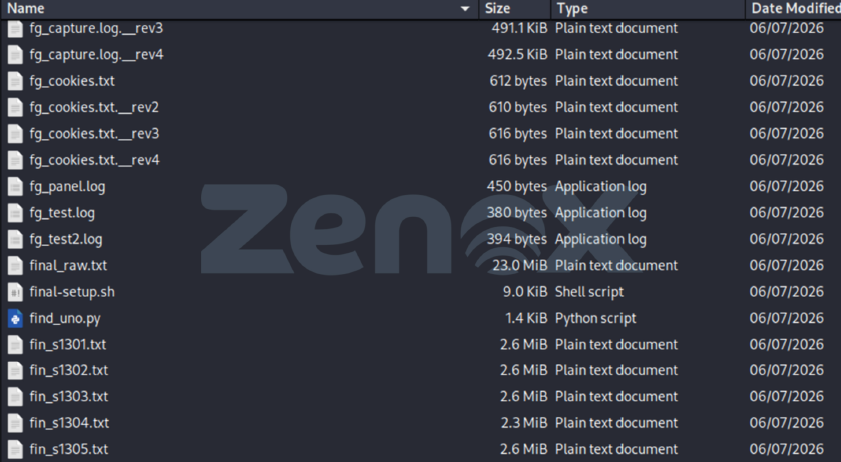
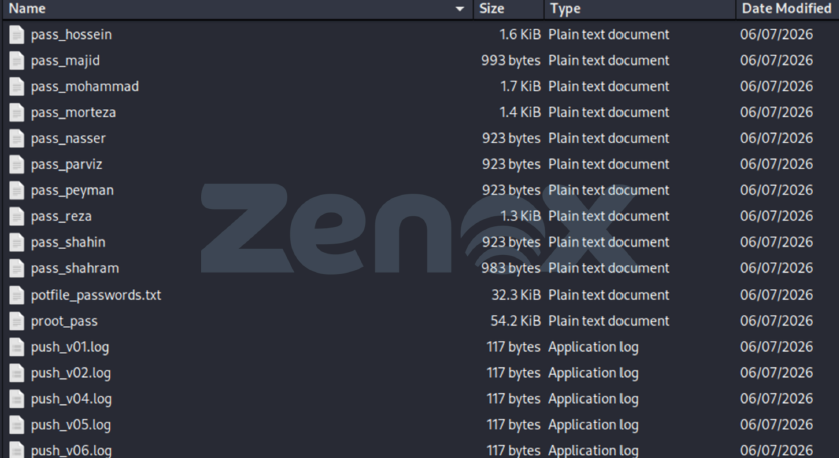
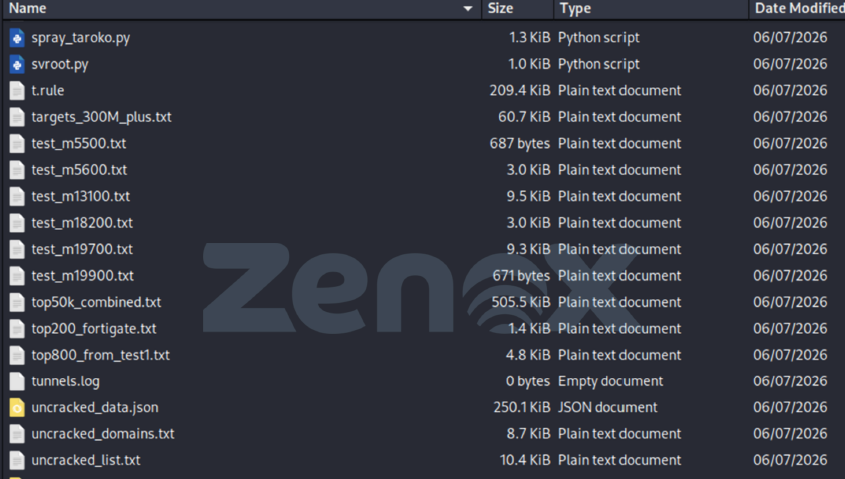
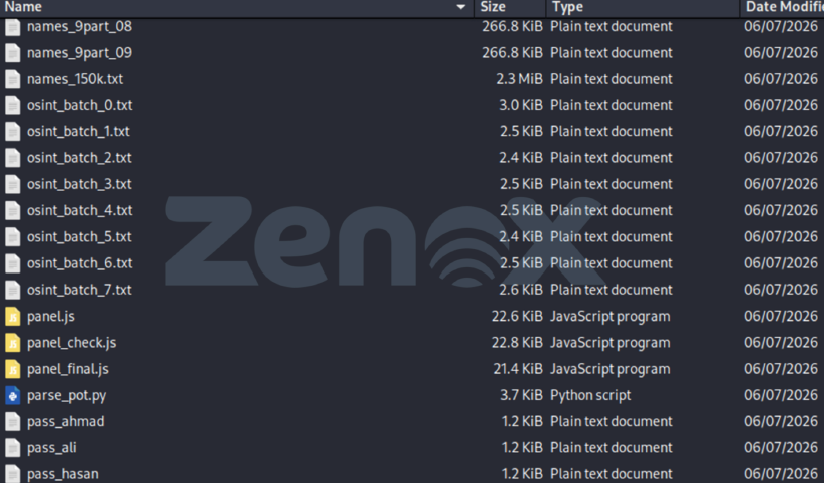
In June 19 2026 we received access to the contents of an internet-exposed directory, left open by the operators themselves of a campaign the press named FortiBleed. It was not a victim leak. It was the attacker command post: roughly 318 files containing the tooling, scripts, target lists, operational logs, and stolen data of a global-scale credential theft operation against Fortinet FortiGate firewalls.
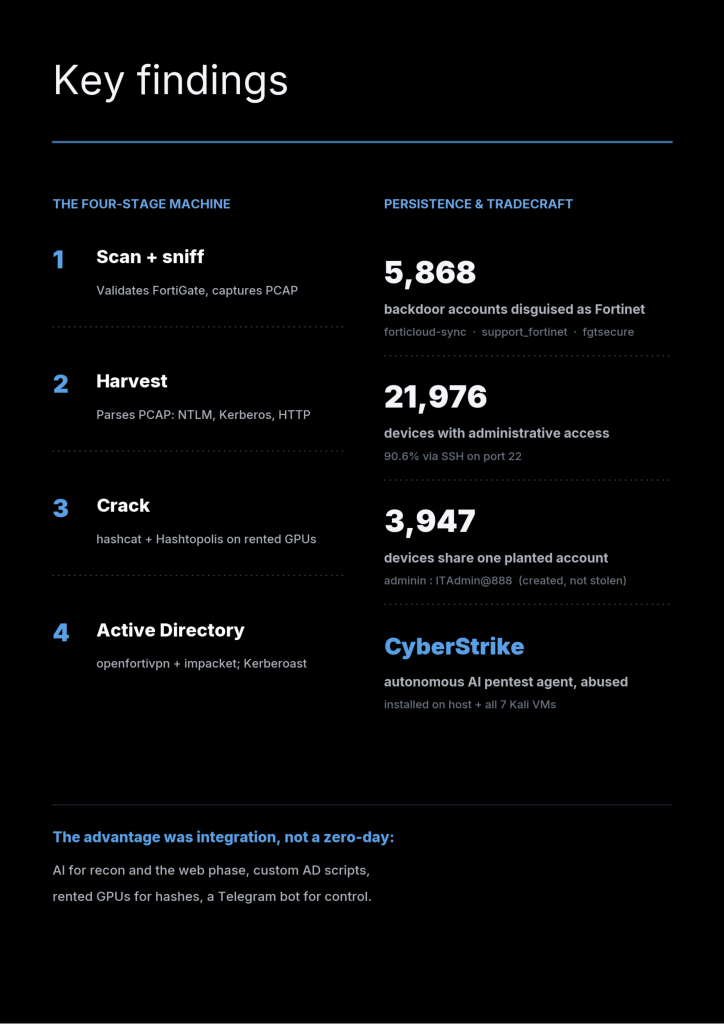
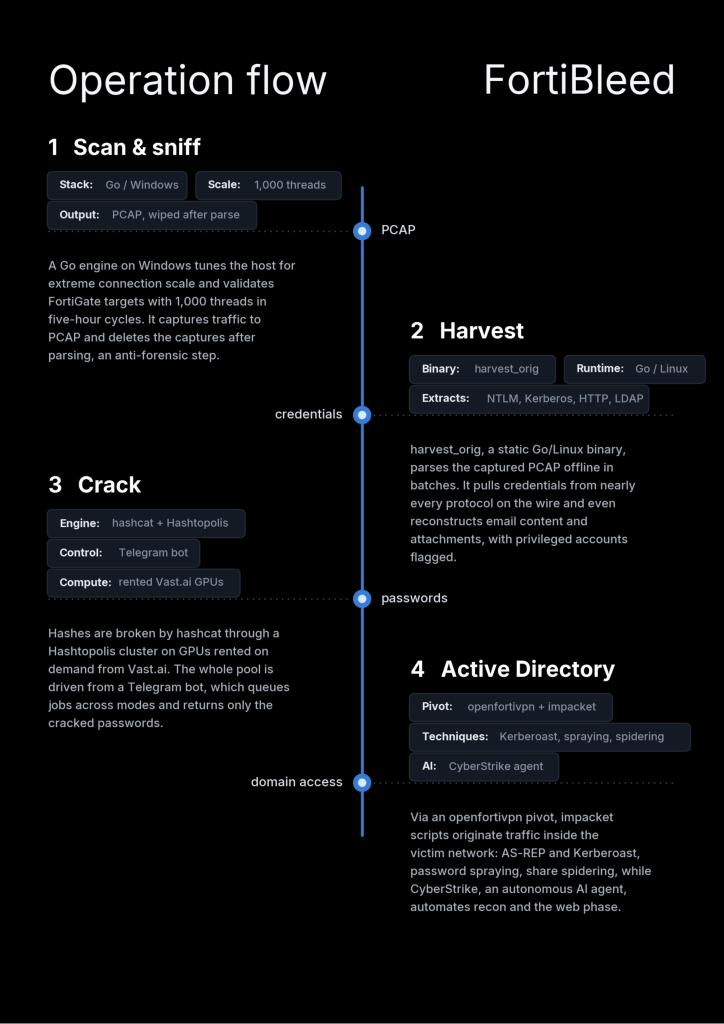
Throughout this analysis, what emerged was not a group of “hackers” in the classic sense, but rather something closer to an industrial assembly line. The operation has four chained stages (mass scanning and traffic capture, credential extraction, offline hash cracking, and movement inside Active Directory), a multi-operator team model with supervision, elastic cracking capacity rented on demand, and, surprisingly, an autonomous AI-powered pentest agent built into the arsenal.
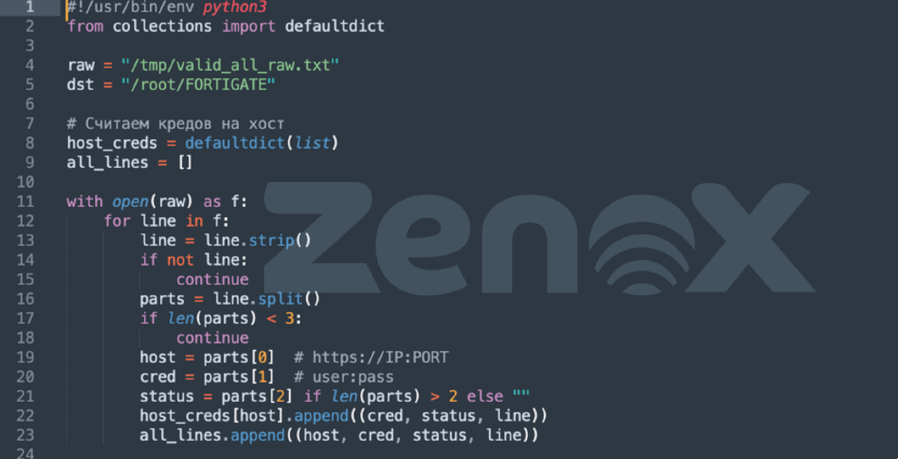
This report reconstructs that operation from the evidence we analyzed file by file. The public figures of the campaign (approximately 73,932 firewalls across 194 countries, around 21,632 domains, close to half of all Fortinet devices exposed to the internet) gain, with possession of the server, the how: how the data was captured, how it was cleaned, how targets were prioritized by revenue, and how firewall access was converted into domain compromise.
1. How we got here
1.1 The discovery of the open directory
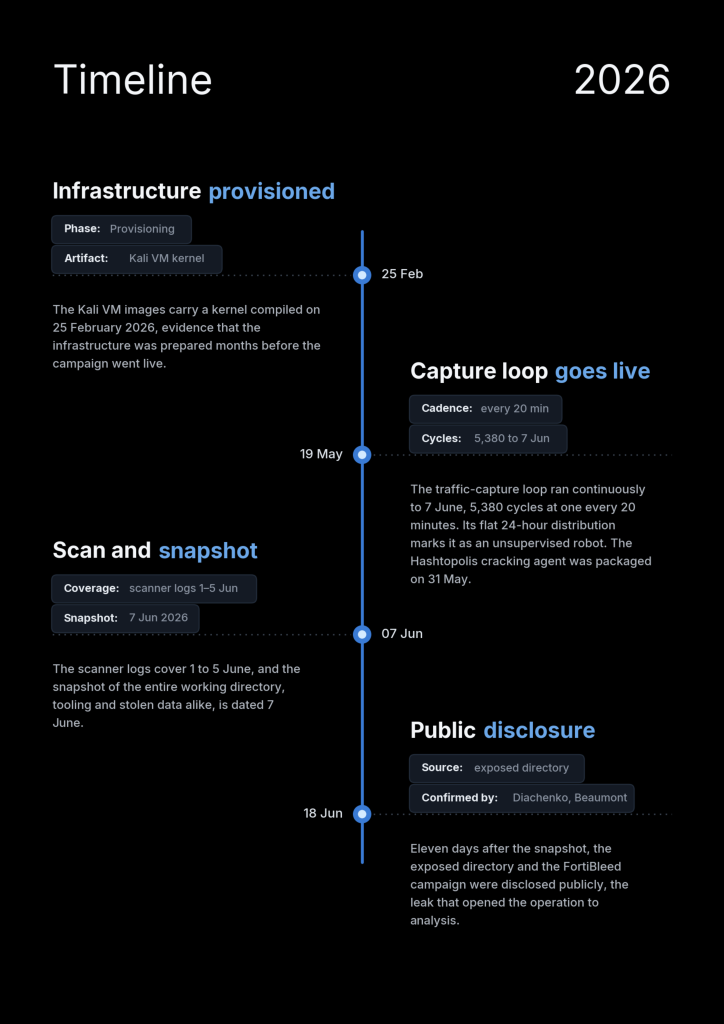
The FortiBleed campaign became public on June 17, 2026, after researcher Volodymyr “Bob” Diachenko located an internet-accessible server tied to the attacking group. Researcher Kevin Beaumont personally validated credentials from the set across multiple organizations and confirmed they were real and active. The detail that makes this case rare is simple: the group left its own working directory exposed, with tooling, connection strings, scripts, and data, all accessible without authentication.
It was this set of files that we received for analysis. From here on, we describe what we found upon opening them, in the order in which the findings began to make sense.
1.2 What we received
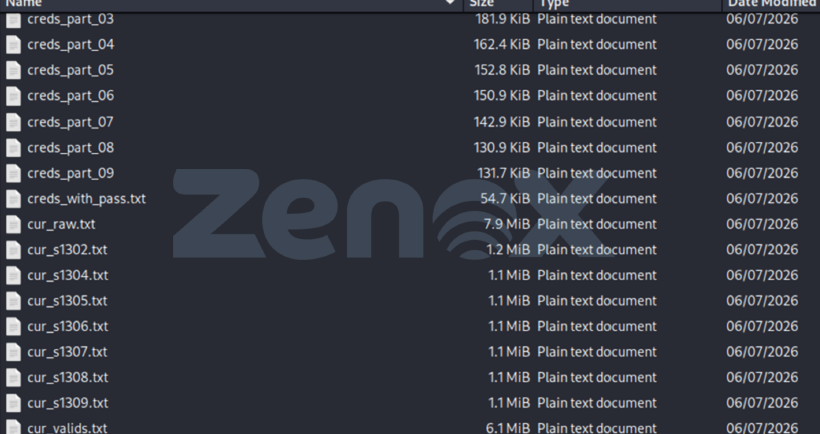
The material is a snapshot of the operational server. The files carry a copy date of June 7, 2026, but the internal timestamps (logs, builds, captures) concentrate the activity between May 19 and June 7, 2026. The content is distributed across five layers, which became the roadmap of our investigation:
- 1.Cracking orchestration (Telegram bot, Hashtopolis, hashcat, GPUs).
- 2.FortiGate credential collection and sniffing (web automation, session capture, traffic harvester).
- 3.Data pipeline (cleaning, deduplication, honeypot removal, OSINT and revenue enrichment).
- 4.Post-exploitation and lateral movement (impacket over LDAP, SMB and Kerberos, password spraying, Active Directory auditing).
- 5.Infrastructure (Kali VMs on KVM, multi-operator SSH mesh, a custom web panel, and an offensive AI agent).
1.3 Scope, objectives and responsible handling
Our objective is defensive: to understand the tradecraft, extract actionable indicators, and enable victim notification. For that reason, throughout this report, passwords and individual identifiers have been redacted or aggregated. The indicators we publish in full are attacker-side (command and control IPs, tokens, vouchers, keys, planted accounts), because they serve the defense.
2. What FortiBleed is
2.1 The public picture
FortiBleed is a massive credential-compromise campaign against Fortinet FortiGate devices, that is, the firewalls and SSL-VPN concentrators of those organizations. The figures released by the press are striking: approximately 73,932 unique firewall URLs across 194 countries, around 21,632 affected domains, and something close to half of all Fortinet devices exposed to the internet.
The volume of activity is also impressive: roughly 1.16 billion credential attempts against 320,777 FortiGate targets, plus 2.1 billion brute-force attempts against 163,650 Microsoft SQL Server hosts, which shows the operation went well beyond Fortinet.
Despite the name evoking “Heartbleed,” FortiBleed is not a memory bug nor an isolated vulnerability. It is a credential harvesting operation combined with offline cracking at industrial scale. The press links the context to CVE-2026-24858 (a FortiCloud SAML SSO authentication bypass, with CVSS up to 9.8, disclosed by Fortinet on January 27, 2026), but there is no confirmation that all the collection came from that flaw. What amplified the campaign was the storage of credentials with weak hashing schemes (SHA-256 with salt) in older configurations, which makes offline cracking viable, plus password reuse and exposed management and VPN interfaces.
2.2 Where this server fits
The server we analyzed is the offensive infrastructure of that campaign. It contains both ends of the story: the tools that generate the attack and the results (credentials, hashes, victim lists). It is the opportunity to read the production line from the inside.
3. Stage 1: mass scanning and traffic capture
The two largest logs in the directory were named crash_170.log and crash2.log, and at first glance looked like error dumps. They were not. Upon opening them, we found the operational logs of the scanning and traffic-capture engine, a component distinct from the harvester.
3.1 The scanner and sniffer engine
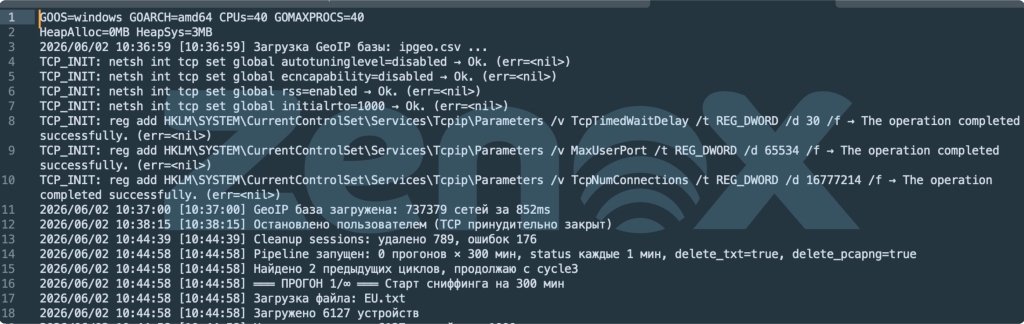
The log opens with the binary signature: GOOS=windows GOARCH=amd64 CPUs=40 GOMAXPROCS=40. In other words, the scanner is a tool written in Go running on Windows, with 40 cores. It starts by tuning the system for extreme connection scale, via netsh and registry edits, and loads a GeoIP database (ipgeo.csv) with 737,379 networks.
The operation runs in a pipeline of 300-minute (five-hour) cycles, with status every minute. In each cycle it loads a regional target list (in this instance, EU.txt, with 6,127 devices) and validates with 1,000 simultaneous threads, displaying counters of success, failure, timeout, and warning. In the first cycles the successful validation rate hovered near 90%. We counted 22 runs, 114 cycles, and approximately 4,202 distinct public IP addresses in this log alone from the European campaign.
3.2 Anti-forensics
One pipeline parameter caught our attention: delete_txt=true and, above all, delete_pcapng=true. The engine deletes its own traffic captures after processing them. It is a deliberate anti-forensics decision: the raw traffic, which would be the heaviest evidence, is destroyed, and only the already-extracted credential remains. This reduces the disk footprint and hinders forensics should the server be seized.
4. Stage 2: credential collection
Here is the central finding of the whole investigation, and it was hidden in a file that the initial triage had labeled merely as “static ELF, scan engine.”
The file harvest_orig is a 64-bit ELF binary, static, compiled in Go (with the crypto/internal/fips140 runtime present), not stripped of symbols, 4.3 MB. Its SHA-256 hash is 2758f4d71a2a2dfdefab81737c2d776b2a3dafe5844fdd2157e089a28447ca98 and the BuildID is 268a8420b791df46380ed9ad69905207e15d8a7c. Its command-line flags are –harvest-only and –threads=N.
When we ran strings on it, the role became unmistakable. Messages such as Found %d capture files (%d large >5MB, %d small in %d batches) and captured from PCAP reveal that it parses traffic capture files (PCAP) offline, in batches, multithreaded, with progress reporting in gigabytes processed and MB/s. It is the complement of the Stage 1 scanner: the scanner captures the traffic, and harvest_orig digests it.
The catalog of harvester output files, extracted from the strings, is what explains the origin of nearly the entire server dataset. It extracts credentials from virtually every protocol that passed through the captured network:
- Windows and Kerberos authentication: NTLMv1, NTLMv2, Kerberos RC4 pre-authentication, AS-REP, Kerberoast, and AES pre-authentication.
- Web and directory: HTTP (Basic, Form, and JSON), LDAP (bind DN and password).
- Databases and services: MSSQL, MySQL, FTP, Telnet, RADIUS, SNMP (communities), SSH (banners).
- Generic: cleartext, authentication tokens, session cookies.
Each credential comes out with source and destination context (the format source -> destination | protocol | type | credential), which is exactly the format we saw in all_creds_with_context.txt, real_http_creds.txt, and ldap_creds.txt. The harvester also proactively separates a file of privileged accounts, and uses a dedicated regular expression to extract usernames from HTTP parameters.
Among the output files is a set dedicated to email: addresses, messages with credentials, a summary and, notably, email attachments (emails/email_attachments.txt). The harvester is not limited to credentials; it reconstructs and exfiltrates email content captured in transit.
The significance matters for correcting the public narrative. It is said that the group “intercepted SSL-VPN authentication hashes.” The reality is much broader: from the traffic that passed through the compromised FortiGate devices (recall there is a robot, documented in fg_capture.log, that logs back into the admin panel every 20 minutes and dumps the session table), harvest_orig extracts every type of credential and even email content, already enriched with context and with the privileged accounts highlighted. This binary is the stage zero that feeds the entire cleaning and enrichment pipeline. The name harvest_orig, “harvest original,” suggests it was the reference version of the tool.
5. Stage 3: offline cracking at industrial scale
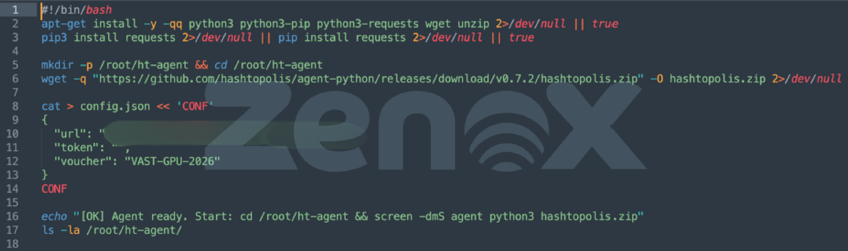
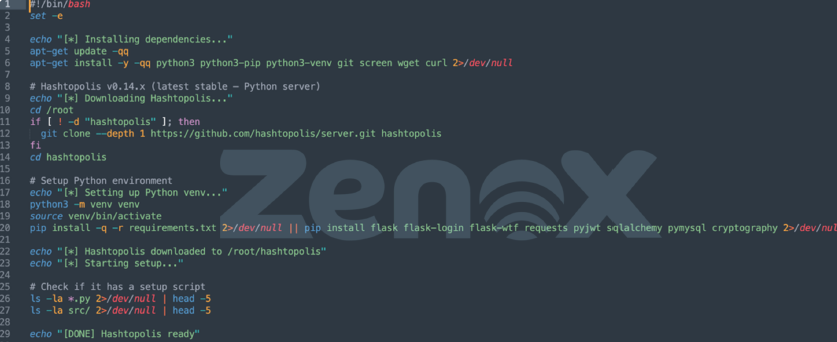
The hash-cracking layer is distributed. The scripts setup_hashtopolis.sh and setup_agent.sh stand up a Hashtopolis server at 85.XX.1XX.8:8443, with the access key HP_MASTER_KEY_2026, and configure agents with the voucher VAST-GPU-2026. That “VAST” prefix is revealing: the GPUs come from Vast.ai, a marketplace for renting cards on demand. In other words, the cracking capacity is elastic and disposable: it turns on when there is a queue of hashes, turns off afterward, and is practically impossible to take down with a hardware takedown. The ht_agent.zip in the directory is the official Hashtopolis agent (version 0.7.2), the piece that runs on each rented GPU.
5.1 The Telegram bot
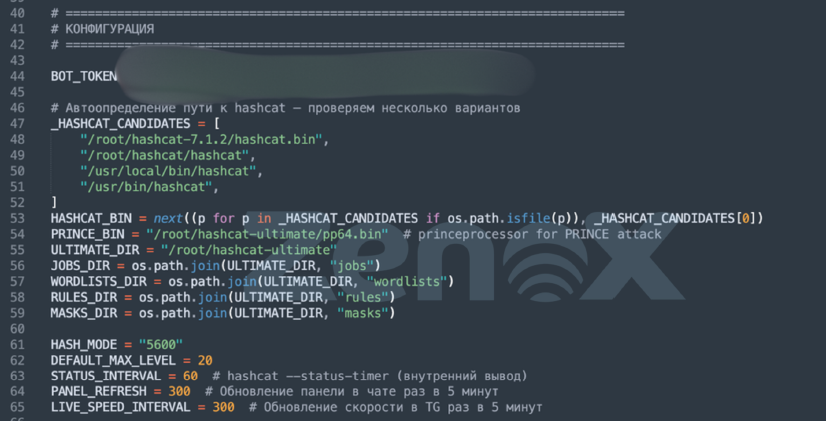
Control of the cluster is done through a Telegram bot, the file bot.py, with 4,525 lines. Its header describes itself as “Telegram Hashcat Bot, NetNTLMv2 Cracker v10.” The administrator is @XXXXsome (user XXXX), authorization is by Telegram username, and the bot token was in cleartext in the code. The bot declares a pool of 10 RTX 4090 cards, manages jobs in parallel, and sends to the chat only the cracked passwords and the final summary, without noise.
The bot supports nine hashcat hash modes, and that list alone shows the breadth of the operation: NetNTLMv2 (5600), FortiGate in MD5 (7000) and in SHA-256 (26300), IPMI RAKP (7300), MSSQL (1731), and the entire Kerberos chain (RC4 pre-auth in 7500, AS-REP in 18200, Kerberoast in 13100, and AES256 pre-auth in 19900). The attack strategy chains steps: direct wordlist, then rules, then a PRINCE attack (via pp64, with words of 8 to 16 characters), then a Random 500K, and finally custom attacks with the operator wordlist and rules. Comparing bot.py with its backup bot.py.bak, we saw about 168 changed lines, all refactoring: per-job hash-mode support (to run different types in parallel more cleanly) and per-step execution time limits, which contain the cost of rented GPUs. It is a tool under active maintenance during the campaign.
5.2 Crack analytics
We assembled a corpus of 30,945 passwords (5,705 unique) from the password fields of the credential files and potfiles. The composition analysis shows the classic weak-password pattern in the long tail (P@ssw0rd, 123456, Month@Year, birth dates), but the top of the frequency list revealed something else, which we address in the next section.
The bot: the victims behind the cracking queue
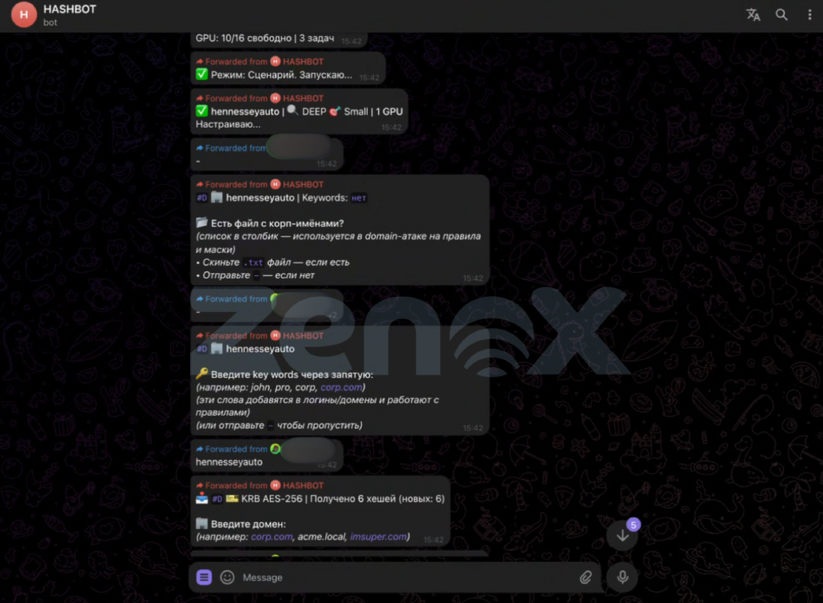
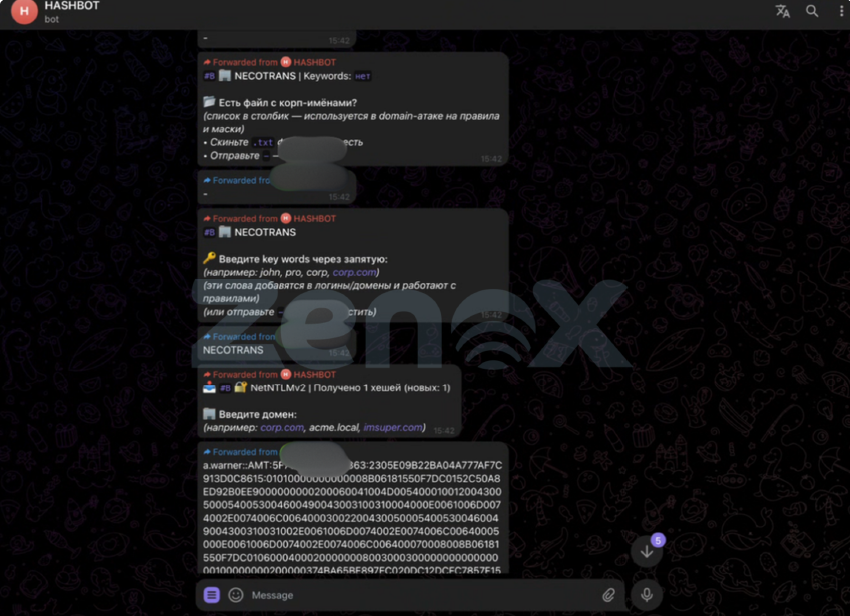
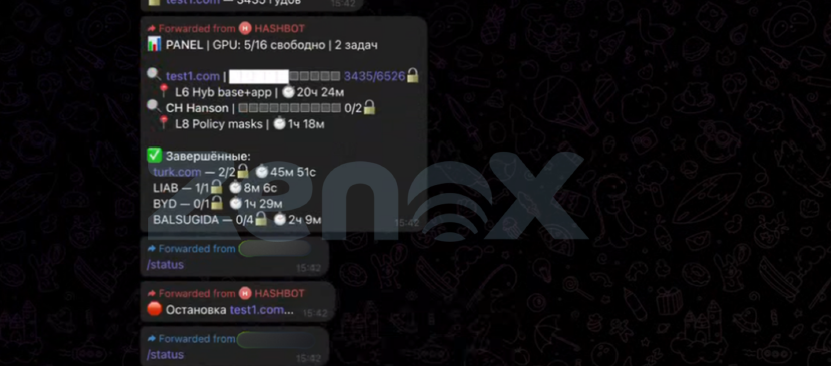
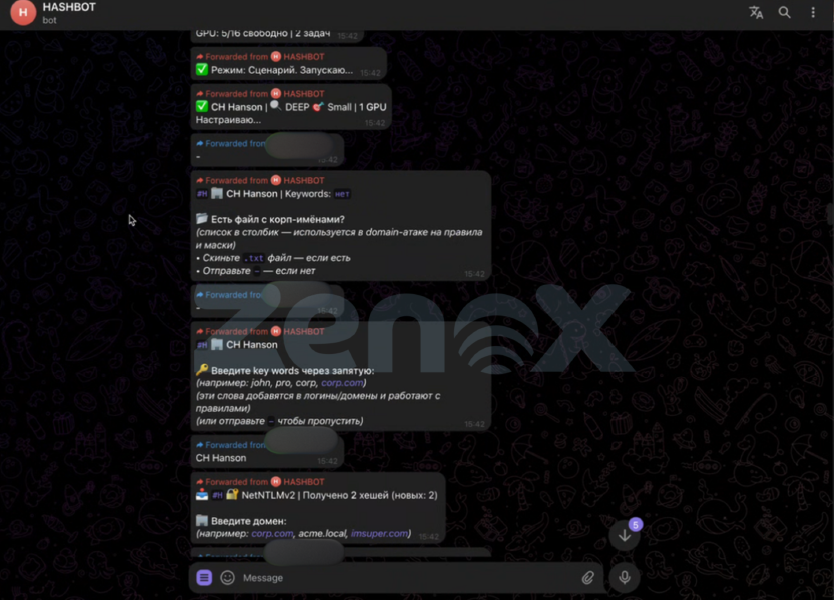
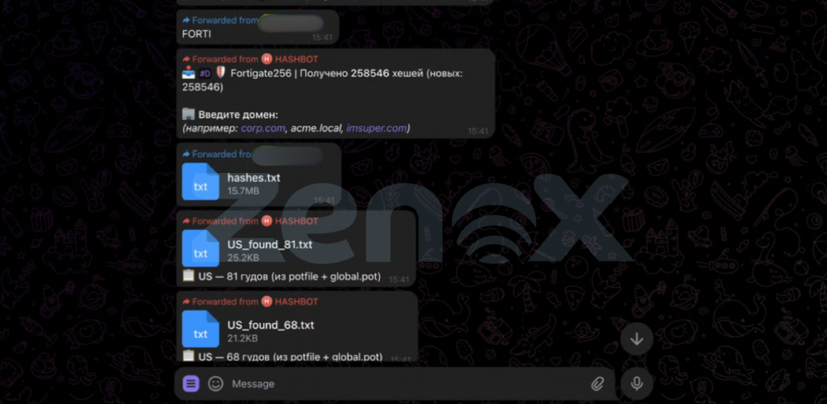
The Telegram bot was not only referenced in the code, its token sat in cleartext inside bot.py. Using it, a external agent reached the live instance, “HASHBOT”, and recovered its forwarded operational history. That history works as a job ledger: for every target it records the submitted domain, the hash type, the attack mode, the GPU allocation, and the results.
What the ledger makes clear is that the operation reached well beyond the FortiGate corpus. Alongside the expected Fortinet batch (a “Fortigate256” job ingesting 258,546 hashes at once), the queue carried discrete jobs tagged with the names or domains of specific organizations, each pushed through the same pipeline the report describes: domain, then keywords, then mode (DEEP SMALL, L6 Hyb base+app, L8 Policy masks, COMBO Combo+rules).
The behaviour matched our earlier findings exactly, the nine-plus hashcat modes (NetNTLMv2, FortiGate, Kerberos RC4/AES-256, MSSQL), a GPU pool with live free/busy counters (for example “GPU: 10/16 free”), per-job ETAs landing on 8 June 2026, and output limited to cracked passwords plus a per-target report file (turk.com_report.txt, US_found_81.txt, and similar).
Among the targets we observed being actively cracked in the queue:
- BYD – the automaker, run as a COMBO (combo + rules) job across the GPU pool.
- Lindab (job tags LIAB / LIAB.LINDAB) – NetNTLMv2 and domain hashes, with credentials recovered.
- Necotrans (NECOTRANS) – logistics; a NetNTLMv2 capture submitted with corporate keywords.
- Hennessey (hennesseyauto) – Kerberos AES-256 hashes.
- CH Hanson (CH Hanson) – NetNTLMv2, processed as a scenario job.
- turk.com – domain credentials cracked, including an administrator account recovered from a DEEP SMALL run (credential withheld).
- Additional tagged jobs such as BALSUGIDA, DTIS, and a batch labelled US (dozens of hashes cracked per file) in various stages of completion.
The takeaway is that the FortiGate credential harvesting was only the front end of a broader, on-demand credential-cracking service: the same bot and GPU pool were used to break Active Directory, Kerberos, and database hashes for a roster of unrelated mid-to-large enterprises.
Per our disclosure policy, the full and confirmed list lives only in the confidential victim deliverable; the names above are cited to illustrate the scope, and each affected organisation is being routed for notification.
6. The persistence layer: backdoor accounts
When sorting the passwords by frequency, the most common pairs repeated across thousands of distinct IP addresses. That is not organic victim credential; it is an account planted by the attacker. The pair adminin:ITAdmin@888 appears on 3,947 devices; fortiAdmin:fortiAdmin1qaz2wsx on 1,282; fgtsecure:F0rt!n3tS3cur3! on 1,152.
When the same username and password combination exists on thousands of firewalls, it was created, not discovered.
6.1 FortiCloud and Fortinet support disguise
The cleverest detail is the disguise. The names of the planted accounts imitate legitimate Fortinet services: forticloud-sync, forticloud-tech, support_fortinet, fgtsecure, fgtsec, Technical_support, fortinetadmin, tech-fortinet. An inattentive administrator who sees forticloud-sync in the account list tends to assume it is something legitimate from the FortiCloud ecosystem. That is exactly the point.
At least 5,868 accounts in the set follow this disguise pattern, and the number exceeds nine thousand when adding variants such as adminin and fgtsec. The confirmed-access inventory, all_valid.txt, lists 21,976 devices with administrative access, 90.6% of them via SSH on port 22. The defensive implication is direct and severe: changing the original administrator password does not evict the attacker, because the attacker has their own account. For defenders, these account names are hunting indicators of immediate use.
7. Stage 4: into the network, VPN pivot and Active Directory
Compromising the firewall was never the end goal. It was the entry door. The real target is Active Directory.
The file vpn5.conf is an openfortivpn client configuration pointing to a victim SSL-VPN concentrator (185.XX.XXX.XXX:444), with an account named sslvpn and a password ending in “Audit.” The name “audit” is no coincidence: it is persistence disguised as a security audit. The configuration uses split tunneling (set-routes=0, set-dns=0), which avoids routing the operator traffic through the victim network, an opsec concern that reappears in the VMs README.
7.1 The impacket arsenal
A collection of Python scripts uses the impacket library to operate from inside the networks. They all share one trick: they socket bind to an address assigned by the VPN (such as 10.212.134.220 or 10.11.254.200) to originate traffic through the compromised VPN, as if they were a legitimate internal host.
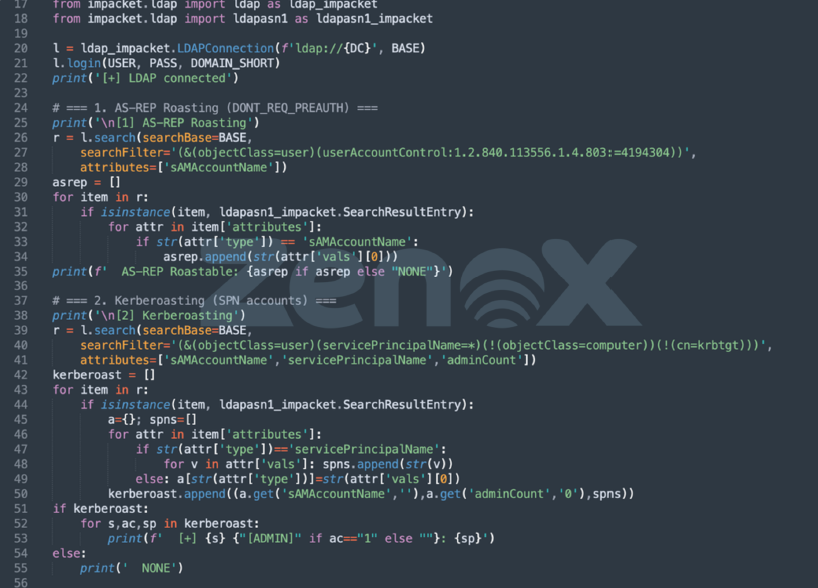
The ad_full_audit.py script runs an AD audit in twelve steps: AS-REP roasting, Kerberoasting, unconstrained and constrained delegation, RBCD, LAPS and gMSA passwords, passwords in the description field, accounts with adminCount=1, old and vulnerable operating systems, the DnsAdmins group, and a GPO count. It is a complete privilege sweep, of the kind a professional pentester runs, automated.
7.2 Spraying and spidering
Other scripts handle the expansion. spray_da.py does password spraying via Kerberos, spray_taroko.py tests already-obtained credentials against SMB by checking access to the C$ share, and spider.py walks the shares recursively, opening files with extensions such as .bat, .ps1, .ini, and .config in search of the words “password,” “secret,” and “net use.”
There are also per-employee custom wordlists (files pass_<name> with Persian and Arabic names, containing numeric PINs in date or phone style), and spray_results.txt documents a successful spray against an Arabic-language organization, where dozens of accounts used trivial passwords such as 12345 and 123456. We confirmed deep compromise (cracked domain credentials) in mid-size organizations in Vietnam, Taiwan, and Japan, among others.
8. The AI angle: CyberStrike
One item from the VM provisioning led us to one of the most relevant discoveries of the research.
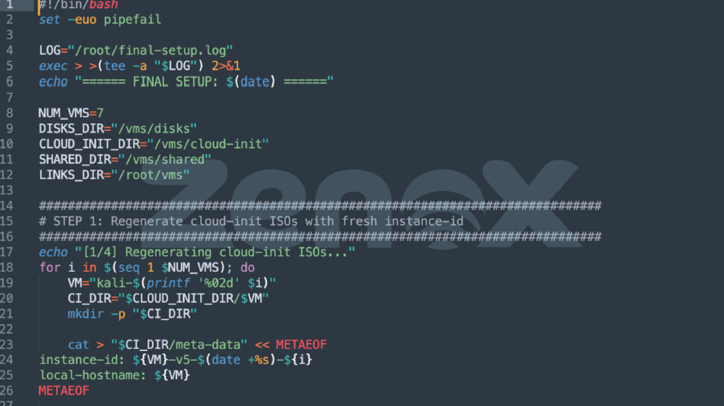
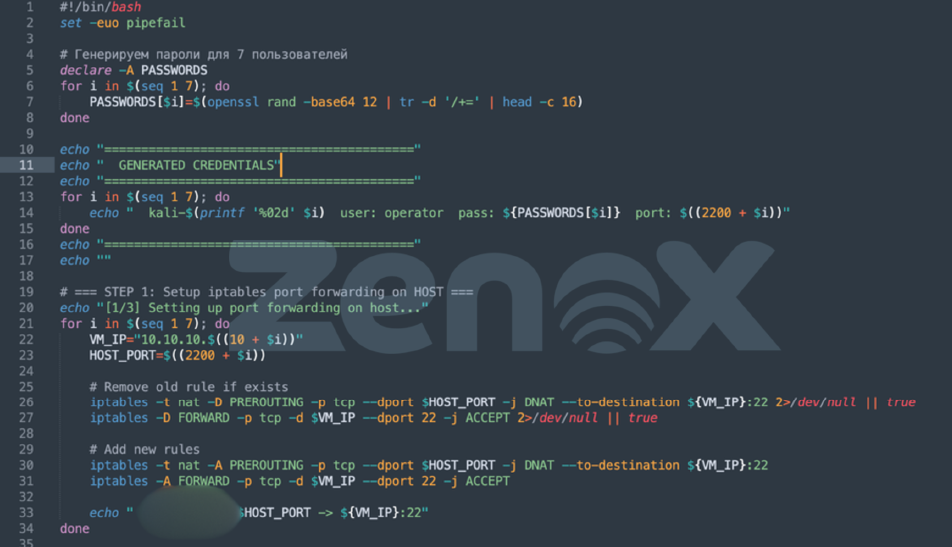
The scripts final-setup.sh, rebuild-vms.sh, and fix-vms.sh install, on the host and on all seven VMs, a tool called CyberStrike, via curl -fsSL https://cyberstrike.io/install.sh | bash. Web research clarified what it is: CyberStrike is an autonomous AI-powered pentest agent, open-source under the AGPL license, written in TypeScript on the Bun runtime and run as a TUI in the terminal. It turns an LLM subscription into an automated red team, with more than 13 specialized agents, more than 7,300 skills, more than 2,000 MITRE ATT&CK atomic tests, an embedded Chromium browser with HTTP interception (the HackBrowser), eight parallel sub-testers (IDOR, authorization bypass, SSRF, injection, business logic, among others), and a remote-execution mechanism called Bolt, which uses the MCP protocol with Ed25519 authentication. It supports more than 15 LLM providers in the BYOK (“bring your own key”) model, including Anthropic, OpenAI, Google, and offline options such as Ollama.
8.1 How they used it
The evidence of use is consistent. CyberStrike was installed on the host and on the seven Kali VMs, added to the PATH, and cited in the operators README as a first-line tool. There is an Ed25519 SSH key with the comment cyberstrike@pentestlab, which aligns with the Bolt remote-execution mechanism. And there is, on the host, a cache of the terminal interface library libopentui.so (36 identical copies), consistent with a Bun-based TUI application, like CyberStrike itself, having run there. Combining the documented capabilities with the observed infrastructure, the most plausible reading is one of an AI agent per operator, each in its own VM under the supervised tmux session: the HackBrowser and the sub-testers automate the web phase (including interaction with FortiGate panels and internal portals), Bolt orchestrates tools across the VM mesh, and the OSINT module feeds part of the target enrichment. We did not find any attacker LLM key in the dump, which is consistent with the BYOK model, in which the keys live in the local runtime configuration.
8.2 The significance
An honest framing is warranted: CyberStrike is a legitimate tool, intended for authorized testing, with an explicit code of conduct. What we document is its abuse by a criminal actor, who simply ignored that code of conduct and pointed the agent at targets without consent, at scale. FortiBleed is thus a concrete case of criminal adoption of agentic pentesting. The attacker advantage does not lie in a novel exploit; it lies in the integration: AI for recon and the web phase, custom scripts for Active Directory, rented GPUs for hashes, and a Telegram bot for control. The exact scope of the actions executed by the AI is an inference, since there are no CyberStrike transcripts in the dump, but the use of the tool is a fact.
9. The opsec failure that exposed them
There is an irony at the center of this case. The group trained its operators in opsec, with an explicit README about not leaking the infrastructure through the victim network, used split tunneling, encrypted target lists in the panel, detected honeypots, and deleted its own traffic captures. And yet, it left the entire working directory open on the internet, with the private SSH key (cyberstrike_key), the Telegram bot token, and the Hashtopolis access keys exposed. It was that failure that gave up the operation. The tactical discipline did not survive a configuration error in the infrastructure.
10. Impact assessment
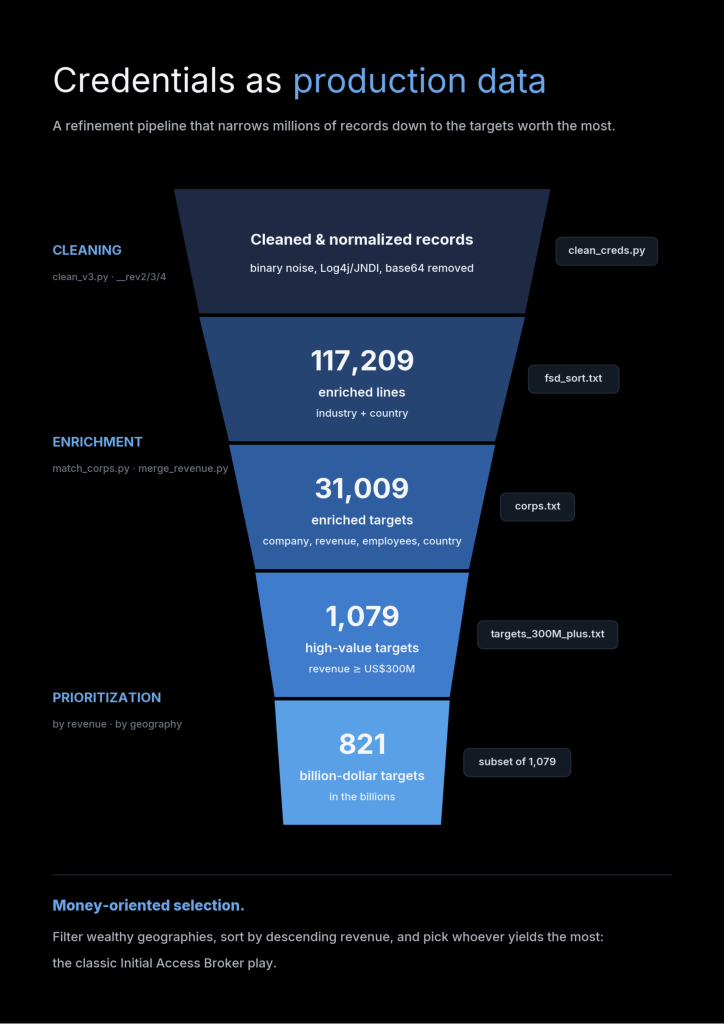
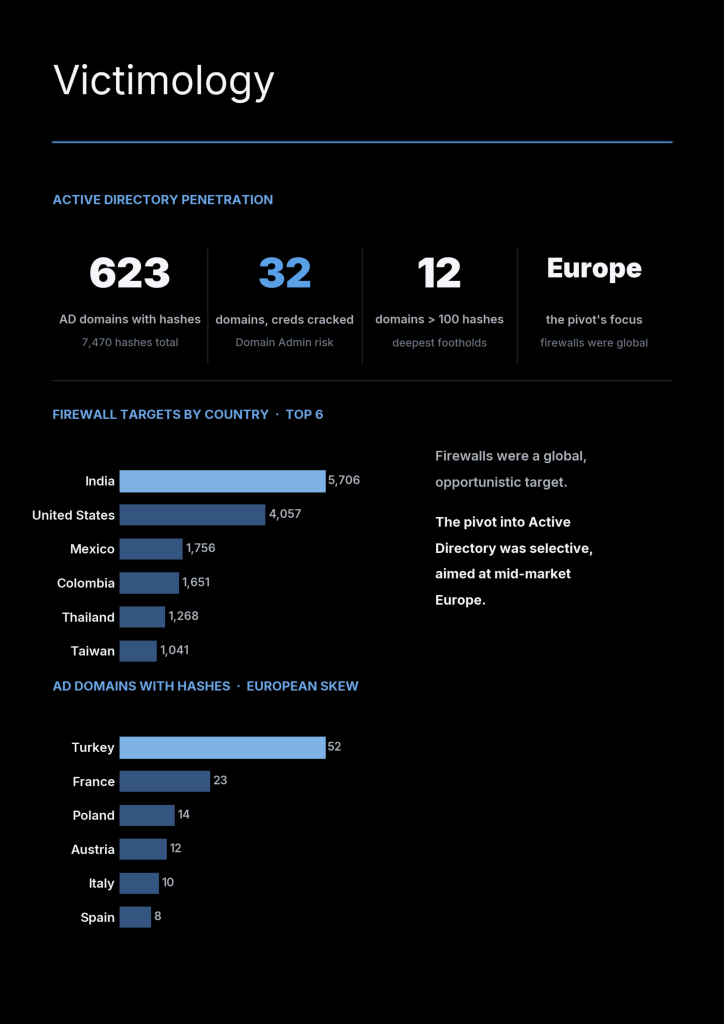
The impact is measured in three layers. At the surface, tens of thousands of Fortinet firewalls with compromised credentials and planted backdoor accounts, which means persistent administrative access. At the intermediate layer, the sensitive traffic of countless organizations was captured and processed, including credentials from multiple protocols and email content. At the deep layer, hundreds of Active Directory domains were penetrated, some down to domain-credential level. Since the already-leaked credentials remain valid until they are rotated, the predominant risk is not that of a one-off exploit, but rather that of persistent and resellable access, in the Initial Access Broker model.
11. Defense and detection
For any FortiGate that had a management interface or SSL-VPN exposed, the recommendation is to assume compromise and act: rotate all credentials (local admin, service accounts, and all VPN accounts), revoke administration SSH keys, take the management interface off the internet, enforce MFA on the VPN, and update FortiOS, remembering to force administrators to re-login so the hashes migrate to PBKDF2.
11.1 Hunting the backdoor accounts
This is the highest immediate-return action. Audit the local administrative accounts of the FortiGate devices and treat as an incident the presence of any account with names of the type forticloud-sync, forticloud-tech, support_fortinet, fgtsecure, fgtsec, fortiAdmin, adminin, or Technical_support. These accounts imitate legitimate Fortinet services, but they are not.
11.2 Detection rules
In behavior, watch for periodic administrative logins from a single IP (the capture loop), anomalous reuse of FortiGate session cookies, and, in Active Directory, surges of AS-REP roasting and Kerberoasting, C$ scanning over SMB, and anomalous reads of LAPS and gMSA. It is also worth monitoring the traffic typical of an offensive AI agent: crawling with interception, single-origin parallel scanning of IDOR and SSRF, unexpected Cloudflare tunnels, and outbound calls to LLM APIs from administrative segments.
12. Responsible disclosure and victim notification
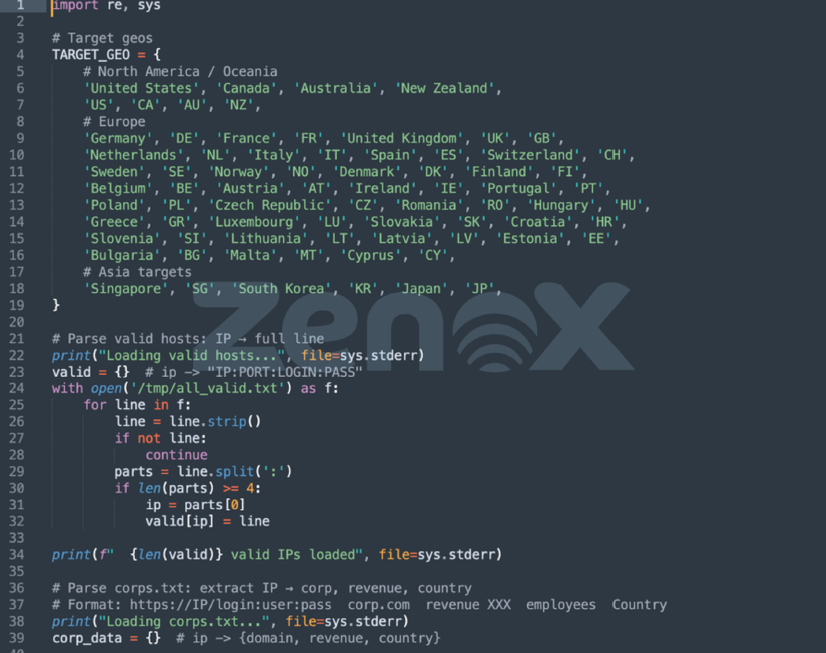
From the loot indexes, we consolidated a notification list containing the organizations with Active Directory compromise: 623 domains, of which 616 with an identified company and 32 with already-cracked hashes (and therefore Domain Admin risk). On principle, this list contains no password or individual username, only what is necessary for a CERT or the organization itself to identify and act. It is a confidential deliverable, intended for trusted disclosure channels (national CERTs or direct victim notification), and is not published in this report, which limits itself to aggregates. The suggested prioritization starts with the 32 domains with cracked domain credentials and the twelve with more than one hundred captured hashes.
13. Conclusion
FortiBleed shows the maturation of the initial-access market as an industry. What made this group effective was not a magic trick, but rather the orchestration: a scanning and sniffing engine that captures traffic at scale and erases the evidence, a multi-protocol harvester that turns that traffic into credentials, an elastic cracking cluster rented and commanded by chat, an AI agent that multiplies each operator force, and a data pipeline that prioritizes victims by revenue. Each piece is, in isolation, accessible; together, they form a factory.
The lesson for defenders is twofold. First, the expensive firewall does not protect against a 12345 password, and the deep compromise came precisely from weak employee passwords and legacy hashes, not from a zero-day. Second, the trend this case heralds is the combination of offensive AI, elastic cracking, and the Initial Access Broker model, that is, the industrialization of initial access, with little skilled labor per target.
The final irony remains: a group so disciplined in training its operators not to leak the infrastructure on the victim network leaked its entire operation through an open directory. That mistake gave us the rare privilege of reading the production line from the inside, and this report is the result.
14. Attachments