
Introduction
In February 2026, the ZenoX threat intelligence team identified an unknown malware family during hunting activity, internally classified as VENON due to references in the code (spelled with an N). The sample was initially flagged for behavior consistent with Latin American banking trojans, particularly the use of banking overlays and active window monitoring, characteristics present in established families such as Grandoreiro and Mekotio.
The fundamental difference emerged during static analysis: unlike all known families in the Latin American ecosystem, VENON does not contain a single line of Delphi code. The binary is compiled entirely in Rust, with 88 external dependencies identified from Crates.
This report documents the results of the technical analysis conducted by the ZenoX Research Team, covering the complete infection chain, malware capabilities, command-and-control infrastructure, and attribution indicators identified during the investigation process. The analysis required building custom tooling and reimplementing the Argon2id + XChaCha20-Poly1305 pipeline used to protect the remote configuration.
During analysis, the team raised the hypothesis that VENON may essentially be an AI-assisted Vibecoding refactor of an already-established banking trojan in the region, possibly Grandoreiro itself, rewritten from scratch in Rust. The fidelity with which classic functional patterns from the Delphi ecosystem, such as the overlay logic, window monitoring, and swap mechanisms, were reproduced in a completely different systems language suggests the author did not start from an original conception, but from a known behavioral base, using generative AI to perform the technical translation.
Additional evidence of AI use was identified in the operator’s own infrastructure: the C2 panel code exhibits AI-assisted generation patterns consistent with what the security community has termed vibe coding, reinforcing the hypothesis that the entire operation, from malware to backend, was built with extensive AI tooling assistance.
As of this publication, ZenoX has not identified any other banking trojan in the Brazilian or Latin American ecosystem with this technical profile. VENON represents, possibly, the first appearance of a Brazilian banker RAT developed entirely in Rust, with a level of sophistication comparable to tools used by known APT groups.
Click here to read the full report
Analysis Complexity
VENON presents a level of static analysis difficulty significantly greater than traditional Latin American banking trojans. While Delphi malware like Grandoreiro or Mekotio can be examined with relative ease, with readable strings, exposed RTTI, and identifiable visual components, VENON combines multiple layers of protection that make each step of the reverse engineering process a distinct technical challenge.
For an analyst familiar with Delphi trojans, where an x64dbg session reveals strings like “Banco handler of Brasil” ou “Itau” nos primeiros minutos, o VENON exige um investimento de tempo and ferramental de ordem de magnitude superior.
| Barrier | Detail |
| UPX with modified headers | Prevents automatic decompression; requires manual header reconstruction before processing the binary |
| Native Rust compilation | Functions with mangled names, 88 crates, no RTTI or debug symbols |
| XOR encryption with 95 unique functions | Each sensitive string is decrypted by a different key derivation function; there is no reusable global key |
| Argon2id + XChaCha20-Poly1305 | State-of-the-art encryption for the remote config; requires reimplementing the KDF parameters to decrypt |
| ChaCha20-Poly1305 in C2 | C2 traffic encrypted per session via ring-0.17.14; passive inspection is not possible without the session key |
| 9 active anti-analysis techniques | AMSI Bypass, ETW Bypass, ntdll overwrite, indirect syscalls, thread hiding, DACL, anti-sandbox, anti-screenshot, and Defender SID Check |
Table 1 – Analysis Barriers
No single tool was sufficient to cover all protection layers. The analysis required building a six-phase pipeline, each feeding the next with the information needed to advance:
| Phase | Tool / Technique | Result |
| Phase 1 | DIE/PE Analysis + manual UPX decompression | libcef.dll unpacked (9.3 MB) |
| Phase 2 | FLOSS v3.1.1 | 130,749 static strings + 41,799 Rust strings extracted; automatic deobfuscation disabled by binary density |
| Phase 3 | Ghidra 12.0.4 Headless | 17,765 functions identified; 500 functions of interest decompiled; 143,093 lines of decompiled C generated |
| Phase 4 | Python + Capstone | 95 XOR blocks processed; 92 successfully deciphered (96.8% coverage) |
| Phase 5 | Reimplementation of Argon2id KDF + XChaCha20-Poly1305 | Remote config decrypted; C2 host confirmed |
| Phase 6 | Categorization of 143,093 decompiled lines | 14 functional groups mapped, 70+ features documented, Rust modules reconstructed |
Table 2 – Analysis Pipeline Adopted
The level of effort required to analyze VENON is itself a metric of the artifact’s sophistication. A trojan that requires building custom analysis tools is not ordinary malware. It is an artifact that reflects advanced technical competence from its author and significantly raises the analysis cost for any incident response or threat intelligence team.
Infection Chain
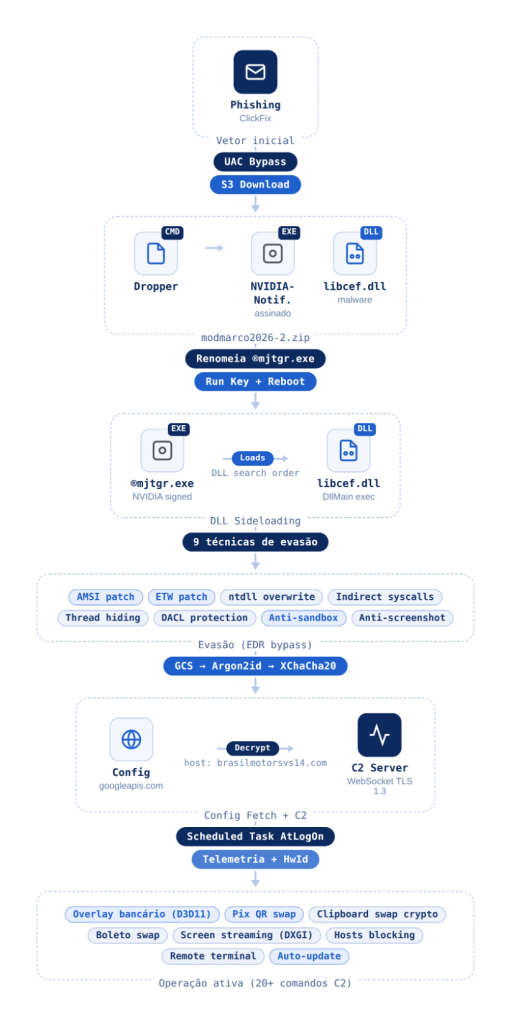
VENON’s infection chain is structured in eleven sequential phases, combining social engineering, multiple evasion layers, and a sophisticated payload delivery mechanism. The campaign demonstrates considerable technical planning, with each phase designed to overcome specific security controls before advancing to the next.
Initial Vector
The confirmed entry vector is DLL sideloading via the legitimate NVIDIANotification.exe installer: the malicious libcef.dll is loaded in place of the legitimate Chromium Embedded Framework by exploiting the Windows DLL search order, which prioritizes the executable’s directory. The initial delivery mechanism for the NVIDIANotification.exe + libcef.dll pair to the victim’s system was not, however, determined with high confidence during this analysis.
It is worth noting that during the period of sample identification, ZenoX observed a significant increase in ClickFix campaigns using NVIDIANotification.exe as the final payload, where the victim is socially engineered into executing a command that downloads and activates the file pair. The correlation between the analyzed artifact and this distribution vector is plausible and is being investigated, but it was not possible to confirm with sufficient confidence to include it as a definitive finding in this report.
The infection chain analysis documented in this report begins from the moment the NVIDIANotification.exe + libcef.dll pair is already present on the victim’s system.
Distribution occurs via phishing emails, fake pages mimicking legitimate portals, or sponsored ads. In all scenarios, dropper execution depends entirely on voluntary victim action; no technical exploit is required at this stage.
Install via PowerShell
Obfuscated batch file of ~1.6 KB. Critical strings (URLs, paths, commands) are reconstructed at runtime by concatenating fragmented variables, avoiding static signature detection.
The script relaunches itself with RunAs via PowerShell if not running as administrator.
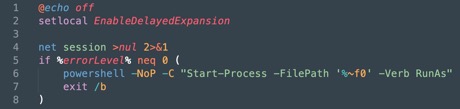
Figure 1 – Privilege Escalation
Adds C:\ProgramData\USOShared\ NuPLihaOH\ via Add-MpPreference before the download. The parent directory mimics the Update Session Orchestrator; the space in the subfolder name impedes command-line searches.
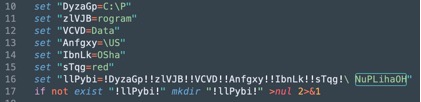
Figure 2 – Defender exclusion
ZIP obtained from S3 bucket via Invoke-WebRequest, with URL dynamically constructed by variable fragmentation.
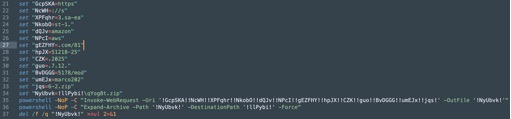
Figure 3 – Payload download
The ZIP contains NVIDIANotification.exe (signed NVIDIA binary) and libcef.dll (malware). The executable is renamed to ®mjtgr.exe; the character ® (U+00AE) in the prefix impedes references via CLI and forensic tools.
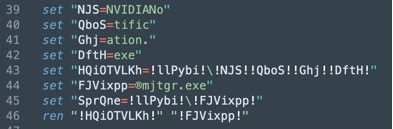
Figure 4 – Extraction and Renaming
Run key added at HKCU\…\Run; individual exclusion created for ®mjtgr.exe.

Figure 5 – Persistence + second exclusion
Script self-deletes via (goto) 2>nul & and forces reboot in 3 seconds (shutdown /r /t 3 /f), activating the run key and eliminating evidence of the entry vector.

Figure 6 – Self-deletion and reboot
DLL Sideloading
After reboot, Windows executes ®mjtgr.exe via run key. Since the Windows DLL search order prioritizes the executable’s directory, the malicious libcef.dll is loaded in place of the legitimate Chromium Embedded Framework.
The process appears in Task Manager with the NVIDIA name and digital signature. The DLL exports the standard functions of a COM object (DllCanUnloadNow, DllGetClassObject, DllMain, DllRegisterServer, DllUnregisterServer) to mimic a legitimate DLL; all malicious code resides in the DLL_PROCESS_ATTACH do DllMain.
Initialization and Evasion
Upon loading, the DLL executes nine evasion techniques in sequence before initiating any malicious activity.
The most sophisticated technique in this phase is the overwrite of the .text da ntdll.dll in memory with the clean version read from disk.
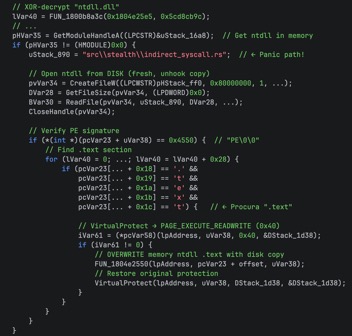
Figure 7 – ntdll .text Overwrite
For sensitive operations, the malware implements indirect syscalls: syscall numbers are read directly from ntdll on disk and stubs are constructed in memory, bypassing any hook that could be reinstalled. Finally, it applies thread hiding via NtSetInformationThread with the flag ThreadHideFromDebugger, modifies the process’s own DACL to deny external access, and configures SetWindowDisplayAffinity nos overlays para que screenshots exibam apenas tela preta.
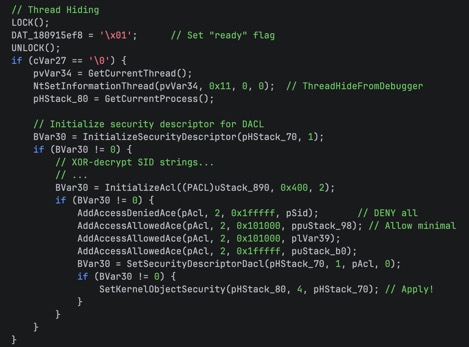
Figure 8 – ThreadHideFromDebugger + DACL Protection
Remote Config Fetch
The config thread makes a GET request to hxxps://storage.googleapis[.]com/mydns2026/startabril2026, with fallback to hxxps://pluginsafeguard[.]help/ipv4/config.enc. Google Cloud Storage is used as the primary channel because it is rarely blocked by corporate firewalls.
The response goes through three decryption layers: Base64 Decode, followed by key derivation via Argon2id (m=19456 KiB, t=2, p=1) with password L0@D_S3CR3T_K3Y_X9F2_PR0D_2024! e salt LOAD_SALT_2024!!, and finally XChaCha20-Poly1305 decryption with a 24-byte nonce extracted from the beginning of the blob. The result is a JSON containing the C2 address: {“host”:”brasilmotorsvs14[.]com”}.
Earlier versions of this RAT used AES-256-CBC with SHA-256 and a zero IV, significantly weaker. The migration to Argon2id and XChaCha20-Poly1305 reflects deliberate technical evolution between versions.
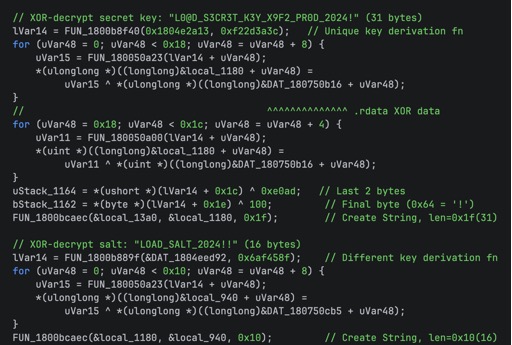
Figure 9 – XOR Decrypt Secret Key + Salt
Persistence and C2
After obtaining the configuration, the malware installs a Scheduled Task named “NVIDIA Notification Service” with trigger AtLogOn and maximum run level, replacing the WMI Event Subscription mechanism used in earlier versions. The WebSocket connection to the C2 is established under TLS 1.3 with ChaCha20-Poly1305 cipher via tungstenite e rustls. Each victim is identified by a HardwareID calculated as the SHA-256 of the computer name concatenated with the volume serial.
Itaú Swap
In addition to the attack mechanisms via banking overlay and clipboard manipulation, VENON deploys two VBScript code blocks extracted directly from libcef.dll. These blocks implement a shortcut hijacking mechanism targeting the Itaú Application, replacing legitimate system shortcuts with tampered versions that redirect the victim to a web page under operator control, preserving the bank’s original icon to avoid suspicion.
This is a VB module exclusive to Itaú; no custom scripts like this were found for other banks and targets.
The attack is operated in two distinct stages: install, which performs shortcut substitution, and uninstall, which reverts the modifications. The presence of the second block indicates the mechanism is controllable via C2, allowing the operator to restore shortcuts before ending the session or upon detecting signs of investigation.
Block 1: Install
The install script is responsible for locating and tampering with all Itaú Application shortcuts present on the victim’s machine. Execution follows four main steps:
- Microsoft Edge Path Resolution: the script queries the registry at HKLM\SOFTWARE\Microsoft\Windows\CurrentVersion\App Paths\msedge.exe. If the key is absent, it tries the WOW6432Node alternative path, then directly checks the standard installation paths at Program Files (x86) e Program Files. If Edge is not found by any method, the script writes -2 to the result file and exits without making modifications.
- Target Location Enumeration: o script define um array com oito locais handler of sistema de arquivos onde atalhos handler of Itau podem existir.
- Itaú Shortcut Identification: for each .lnk encontrado nos locais alvo, o script abre o atalho via WScript.Shell.CreateShortcut e verifica se o TargetPath contains any of the strings itauaplicativo.exe, aplicativo itau ou itauaplicativo. The comparison is done in lowercase to ensure case-insensitivity.
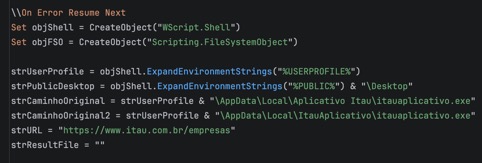
Figure 10 – Itaú Shortcut Identification
- Shortcut Substitution and Icon Preservation: shortcuts identified as Itaú have their TargetPath substituído pelo caminho handler of msedge.exe resolvido anteriormente, and os Arguments definidos como hxxps://www.itau.com[.]br/empresas. The WorkingDirectory e limpo. Criticamente, o IconLocation is preserved if present, making the shortcut visually identical to the original. The number of modified shortcuts is written to the result file.
| Variable / Folder | Expanded Path (example) |
| Desktop (user) | %USERPROFILE%\Desktop |
| Desktop (public) | %PUBLIC%\Desktop |
| StartMenu\Programs | %APPDATA%\Microsoft\Windows\Start Menu\Programs |
| StartMenu\Programs\Itau | …\Programs\Itau |
| StartMenu\Programs\Aplicativo Itau | …\Programs\Aplicativo Itau |
| AllUsersPrograms | %ALLUSERSPROFILE%\Microsoft\Windows\Start Menu\Programs |
| AllUsersPrograms\Itau | …\Programs\Itau |
| AllUsersPrograms\Aplicativo Itau | …\Programs\Aplicativo Itau |
Table 1 – Locations enumerated by the VBS script
Block 2: Uninstall / Restore
The second block implements the inverse operation: it identifies previously tampered shortcuts and restores them to the original Itaú Application executable. The identification logic is distinct from Block 1 and is based on artifacts left by the modification, not the original shortcut attributes.
The script resolves the path to the legitimate Itaú executable by checking two possible installation locations: %USERPROFILE%\AppData\Local\Aplicativo Itau\itauaplicativo.exe e %USERPROFILE%\AppData\Local\ItauAplicativo\itauaplicativo.exe. If neither is found, it uses the first path as a fallback. This suggests the operator can trigger the uninstall even on machines where the application is not installed, possibly to cover tracks before the victim notices the tampering.
The IsModifiedItauShortcut function identifies tampered shortcuts by checking whether the TargetPath aponta para msedge.exe, microsoft-edge, chrome.exe ou firefox.exe, in combination with a Arguments contendo a string itau.com.br. The inclusion of Chrome and Firefox as detection criteria indicates the operator may have attack variants using other browsers, or that the criterion was designed to be robust against future variations of Block 1.
Identified shortcuts have their TargetPath restored to the Itaú executable, the Arguments limpos, and o IconLocation redefined to itauaplicativo.exe,0 if the file exists on disk. The count of restored shortcuts is written to the result file, suggesting the C2 monitors the operation’s success.
Monitored Targets
VENON monitors 33 financial institutions and digital asset platforms, distributed across six categories. Monitoring is performed via window title and active browser domain checks, activating attack mechanisms upon detecting any of the targets below.
| # | Institution | Monitored Domain |
| 1 | Itaú Unibanco | itau.com.br |
| 3 | Santander Brasil | santander.com.br |
| 4 | Caixa Econômica Federal | caixa.gov.br |
| 5 | Banco handler of Brasil | bb.com.br |
| 6 | Nubank | nubank.com.br |
| 7 | Banco Inter | bancointer.com.br |
| 9 | Sicoob | (string parcialmente decodificada; confirmado via titulo “- sicoob”) |
| 10 | Sicredi | sicredi.com.br |
| 11 | Banco Original | original.com.br |
| 12 | Banco Safra | safra.com.br |
Table 1 – Traditional Banks
| # | Institution | Monitored Domain |
| 13 | BTG Pactual | btgpactual.com |
Table 2 – Investment Bank
| # | Institution | Domain / Identifier |
| 14 | PagBank / PagSeguro | pagseguro.uol.com.br |
| 15 | PicPay | picpay.com |
| 16 | Mercado Pago | mercadopago.com.br |
| 17 | Bling ERP | (título de janela: “bling erp”) |
Table 3 – Fintech / Payments
| # | Institution | Monitored Domain |
| 18 | Receita Federal | receita.fazenda.gov.br, gov.br/receitafederal |
Table 4 – Government
| # | Platform | Monitored Domain |
| 19 | Binance | binance.com |
| 20 | Coinbase | coinbase.com |
| 21 | Kraken | kraken.com |
| 22 | Bybit | bybit.com |
| 23 | Mercado Bitcoin | mercadobitcoin.com |
| 24 | Foxbit | foxbit.com |
| 25 | Gemini | gemini.com |
| 26 | Nexo | nexo.com |
| 27 | Ripio | ripio.com |
Table 5 – Exchanges and Crypto
| # | Platform | Identificador |
| 28 | MetaMask | (título de janela: “metamask”) |
| 29 | Trust Wallet | (título de janela: “trust wallet”) |
| 30 | Phantom | phantom.app |
| 31 | Ledger Live | ledger.com |
| 32 | Rabby Wallet | rabby.io |
| 33 | Cake DeFi | app.cakedefi |
Table 6 – Crypto Wallets
The First Brazilian Banker RAT in Rust
During the initial analysis phases, the ZenoX team identified numerous behavioral similarities with established families in the Latin American ecosystem, particularly Grandoreiro: use of banking overlays for visual interception, active window monitoring, registry-based persistence mechanisms, and a command-and-control structure with remote operation capability. At first glance, the artifact appeared to be yet another representative of the classic LATAM banking trojan paradigm.
The fundamental difference emerged during static analysis: unlike all known families in the region, VENON does not contain a single line of Delphi code. The entire binary is compiled from Rust, with 88 crates identified in Cargo.lock and 17,765 functions. This is not merely a Rust loader delivering a Delphi payload, as experimentally observed in Casbaneiro. The final payload, with all attack logic, encryption, evasion, and C2 communication, is native Rust end-to-end.
As of this publication, ZenoX has not identified any other banking trojan in the Latin American or Brazilian ecosystem with this profile. VENON represents, possibly, the first discovery of a Brazilian banker RAT developed entirely in Rust, with a level of technical sophistication comparable to APT group tools.
The Latin American Banking Trojan Ecosystem
Latin America, and Brazil in particular, is the global epicenter of banking trojans. Of the 30 most detected families worldwide, 11 are of Brazilian origin, representing 22% of all detections in 2024. Brazil alone accounts for 61% of banking trojan detections in the region (ESET, 2024).
The ecosystem has historically been dominated by Delphi-written families, a language that offers self-sufficient binaries and ease of GUI development for banking overlays. The table below lists the main active families and their language characteristics:
| Family | Language | Profile |
| Grandoreiro | Delphi | The largest LATAM banker: 1,700 banks, 45 countries, partial MaaS model |
| Mekotio | Delphi | Europa and LATAM, uso extensivo de PowerShell no dropper |
| Casbaneiro | Delphi + Rust* | Experimental Rust use only in the downloader; final payload in Delphi |
| Guildma | Delphi | Also known as Astaroth; XOR string obfuscation |
| Mispadu | Delphi | SAMBA SPIDER; dropper via HTA/VBScript |
| Coyote | .NET + Nim | Emerged in 2024; Squirrel installer; 61 Brazilian banks |
| Kiron | Rust | Rust downloader with DGA and browser credential theft (2024); no banking attack logic in Rust |
| VENON | Rust nativo | Full banking RAT in Rust: 88 crates, active evasion, state-of-the-art encryption |
Table 1 – Profile Comparison Among Latin American Malware
* Casbaneiro used Rust experimentally only in the download component in 2023; the core malware handler remains in Delphi.
The following table compares VENON’s technical attributes with the three most representative families in the ecosystem: Grandoreiro (volume and reach), Coyote (modern language, Brazil), and Mekotio (European presence).
| Characteristic | VENON | Grandoreiro | Coyote | Mekotio |
| Language | Rust nativo | Delphi | .NET + Nim | Delphi |
| Active Period | 2024-2026 | 2017-2026 | 2024-2026 | 2015-2026 |
| Binary Size | 9,3 MB (UPX) | 390-414 MB | ~50 MB | ~20-30 MB |
| Targets (Banks) | 36+ | 1.700+ | 61+ | 50+ |
| Targets (Crypto) | 21 plataformas | 276 wallets | Não | Não |
| Geographic Reach | Brasil | 45 países | Brasil | LATAM + Europa |
| C2 Protocol | WebSocket TLS | RealThinClient | SSL mutual | TCP custom |
| C2 Encryption | ChaCha20-Poly1305 | AES-CTS | AES | XOR + custom |
| Config Encrypt | Argon2 + XChaCha20 | AES-256 | AES | XOR |
| AMSI Bypass | Sim | Não | Não | Não |
| ETW Bypass | Sim | Não | Não | Não |
| ntdll Unhook | Sim | Não | Não | Não |
| Indirect Syscalls | Sim | Não | Não | Não |
| Pix QR Intercept | Sim | Não | Não | Não |
| Boleto Swap | Sim | Não | Não | Parcial |
| Screen Streaming | DXGI (GPU) | Screenshots | Screenshots | Screenshots |
| Operational Model | Solo / artisanal | MaaS (partial) | Solo | Solo |
Table 2 – Comparative Analysis: VENON vs. Established Families
Attribution
Attribution of VENON to a known operator or group presented low confidence throughout the analysis. Although the malware shares several behavioral characteristics with established Latin American families such as Grandoreiro, Mekotio, and Coyote, the structural technical differences are sufficiently deep to prevent high-confidence attribution to any previously documented group or campaign in the region.
Hypothesis: AI-Assisted Development
An element that complicated both the analysis and attribution is the hypothesis that VENON may have been developed with extensive artificial intelligence assistance, which the security community has termed “vibe coding”. The Rust code structure presents patterns suggesting a developer familiar with the capabilities of existing Latin American banking trojans, but who used generative AI to rewrite and expand these functionalities in Rust, a language that requires significant technical experience to use at the observed level of sophistication.
This hypothesis would explain some asymmetries observed in the code: the coexistence of state-of-the-art cryptographic implementations alongside relatively straightforward control structures, and the reproduction in Rust of functional patterns common in Delphi, such as swap logic and window enumeration, with greater technical fidelity than would be expected from a first-time Rust developer. If confirmed, this would be one of the first documented instances of AI use for banking trojan development in Latin America.
Developer Exposure via Compilation Artifacts
During the string extraction process from an early DLL version (January 2026), identified during hunting, the ZenoX team located local compilation paths exposed in the binary. Unlike the version analyzed as the main subject of this report, this earlier sample had not removed the full paths from the author’s development environment.
The exposed paths repeatedly contain the username byst4, revealing the local machine username where the malware was compiled. The sequence of strings present in the binary includes paths such as C:\Users\byst4\.cargo\registry\src\..., a pattern consistent across dozens of entries corresponding to the Rust crates used in the project.
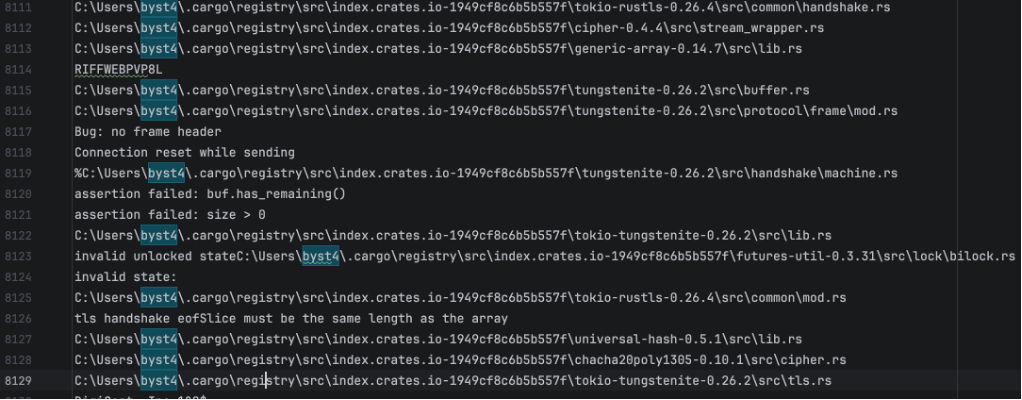
Figure 11 – Username Mention in Rust Crates Exposing the Developer
Indicatores de comprometimento
| Type | Indicator | Description / Contexto |
| Domains | ||
| Domain | brasilmotorsvs14[.]com | Primary C2 WebSocket (Cloudflare) |
| Domain | lazybearpottery[.]net | Alternate C2 (Cloudflare) |
| Domain | digitalmoineyp[.]com | Distribution infrastructure |
| Domain | portalhondihs[.]com | Distribution infrastructure |
| Domain | storage.googleapis[.]com | Dead drop – GCS bucket mydns2026 |
| URLs | ||
| URL | https://s3.sa-east-1.amazonaws[.]com/8151218-25.2025.7.12.5178/modmarco2026-2.zip | Payload – AWS S3 (sa-east-1) |
| URL | https://storage.googleapis[.]com/mydns2026/startabril2026 | Dead drop resolver – GCS |
| URL | https://storage.googleapis[.]com/mydns2026/startmarco2026_1_ | Dead drop resolver – GCS |
| URL | https://storage.googleapis[.]com/mydns2026/startjaneiro_1_ | Dead drop resolver – GCS |
| URL | https://storage.googleapis[.]com/mydns2026/startabril_2 | Dead drop resolver – GCS |
| URL | https://pastebin.com/raw/2qEMcLsD | Dead drop resolver – Pastebin |
| URL | https://digitalmoineyp[.]com/v2/cloudflare/avsmail/recive.php | Distribution endpoint |
| IP Addresses – C2 / Panel | ||
| IP | 104.21.7[.]106 | brasilmotorsvs14.com – Cloudflare CDN |
| IP | 188.114.96[.]3 | lazybearpottery.net – Cloudflare CDN |
| IP | 206.0.29[.]58 | VENON Panel – LACNIC |
| IP | 51.222.75[.]250 | VENON Panel – OVH Canada |
| IP | 51.222.75[.]248 | VENON Panel – OVH Canada |
| IP | 192.99.226[.]117 | VENON Panel – OVH Canada |
| IP | 212.69.5[.]84 | VENON Panel – Europe |
| IP | 34.227.229[.]85 | VENON Panel – AWS EC2 |
| IP Addresses – Abused Legitimate Services | ||
| IP | 34.117.59[.]81 | ipinfo.io – geolocation fingerprinting |
| IP | 142.251.140[.]187 | storage.googleapis.com – dead drop GCS |
| IP | 142.251.141[.]67 | c.pki.goog – CRL validation |
| IP | 142.251.140[.]163 | o.pki.goog – OCSP validation |
| File System Paths | ||
| Path | C:\ProgramData\USOShared\NuPLihaOH\ | Implant staging directory |
| Path | C:\ProgramData\USOShared\NuPLihaOH\NVIDIANotification.exe | Legitimate NVIDIA executable (sideloading) |
| Path | C:\ProgramData\USOShared\NuPLihaOH\®mjtgr.exe | Main implant (Unicode prefix) |
| Path | C:\ProgramData\USOShared\NuPLihaOH\qYogBt.zip | Temporary ZIP in staging |
| Registry Keys | ||
| Registry | HKCU\Software\Microsoft\Windows\CurrentVersion\Run | Persistence – executes ®mjtgr.exe at logon |
| Processes | ||
| Process | ®mjtgr.exe | Main implant (PID 6864) |
| Process | NVIDIANotification.exe | Legitimate NVIDIA executable – sideloading vehicle |
| Process | CasPol.exe | LOLBin – sideloading target |
| Process | wscript.exe | VBS script executor |
| Files | ||
| File | libcef.dll | Malicious DLL – sideloading via CEF (packed) |
| File | NVIDIANotification.exe | Legitimate NVIDIA executable used as loader |
| File | ®mjtgr.exe | Renamed implant (Unicode ® prefix) |
| File | qYogBt.zip | Temporary ZIP in staging |
| File | modmarco2026.zip | Versioned payload – hosted on S3 |
| File | DocumentReclamaAQUI_56b2ca9811.cmd.bin | CMD dropper (phase F1) |
| File | Itau_swap_install.vbs | VBS Script – Itaú shortcut swap |
| File | startabril2026 | Dead drop resolver – GCS |
| File | startmarco2026_1_ | Dead drop resolver – GCS |
| File | startjaneiro_1_ | Dead drop resolver – GCS |
| File | startabril_2 | Dead drop resolver – GCS |
| Hashes | ||
| MD5 | 427ccfa456ed27a819aa152708212ff4 | libcef.dll (packed) |
| SHA256 | c482286a7fdfb64d308c197a4deabcd773b8b62d9e74d1d08fcfd02568d75d72 | libcef.dll (packed) |
| MD5 | 2d1c4778094ba0e1a6e13bb67ce1b631 | libcef.dll (unpacked) |
| SHA256 | 75d1a2560cf93c6a028aa3573febddaf713014d64b0e8904488111772e4cff49 | libcef.dll (unpacked) |
| MD5 | a99cb35768489b7aacf2d31d33d8f541 | Itau_swap_install.vbs |
| SHA256 | fd5d9effc1ef77a49b0720d2691bc144f513609760c22fa62bc1e8b84dedf879 | Itau_swap_install.vbs |
| SHA256 | 78b62856878cb09602b14104df18ca2bedac8640e09d74b934ff3ea0e15627f3 | Amostra adicional |
| SHA256 | d61be2b21e135726c547a388ecb47552559e5221894f5005ce35bdb24efc0c26 | Amostra adicional |